
It’s election year. Democracy relies on people contributing views in the marketplace of ideas.
Contributing ideas from a Christian perspective is a way we can help our country move towards God’s vision called the kingdom of heaven or the reign of God.
One strand of our congregation’s new five-year plan is speaking out. It is a part of what it means to follow Jesus. The living Christ influences how followers vote, the values we promote and the questions we ask. It is a way we seek to participate in the reign of God. This article aims to help us shape questions of political aspirants.
It concerns tax
Tax figures prominently in the story of Jesus’ birth. Luke 2 in the Authorised Version states – “And it came to pass in those days, that there went out a decree from Cæsar Augustus, that all the world should be taxed. (And this taxing was first made when Cyrenius was governor of Syria.) And all went to be taxed, every one into his own city.” Tax is named at the start of talk of Jesus. No wonder it has become an issue Christians discuss.
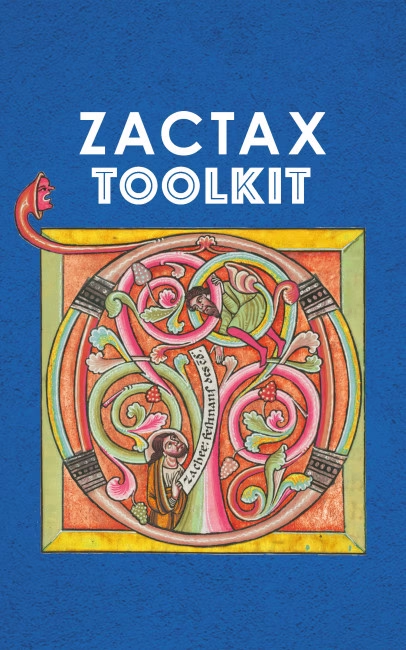
World church bodies like the World Council of Churches, the World Communion of Reformed Churches and the World Methodist Council have been promoting tax justice through The Zacchaeus Tax Campaign. It calls for a global tax and economic system that acts like Zacchaeus, the tax collector in the New Testament.
They have produced a toolkit: Zac Tax Toolkit*. They state: “a fair tax policy – in today’s predominantly capitalist societies – is not only a very effective leverage to fight or reduce poverty, inequality and ecological destruction. Social and ecological tax justice is also indispensable for the functioning of democracy at the national level, and for the equal and peaceful coexistence of the international community at the regional and global level. … tax injustice is one major part of the compelling story about why poverty persists in a world of plenty.”
The statement from the church bodies calls for steps to be taken. The first is: “We call for the enactment of progressive wealth taxes at global and national levels to curb the growing concentration of wealth in the hands of an increasingly powerful few, hand-in-hand with increased public spending to stamp out
poverty.” Another is: “We urgently call for progressive carbon and pollution taxes at different levels to protect our only planetary home.”
In 2004, I participated in a world church meeting about such issues in Accra in Ghana. I suggested that perhaps a way forward was to engage world bodies that had views different from our own. I had in mind talking with people like Mike Moore, New Zealander, who had been Director General of the World Trade Organization. The suggestion was supported by wealthy countries of the North. Churches of the South strongly opposed the suggestion, speaking from their painful experience of disempowering poverty in a deeply unequal world. It challenged me to reflect on what I could do as a brother in Christ, in solidarity. Perhaps a question is – How do our aspiring representatives envisage a tax system that reduces inequality and enables climate justice?
Kerry Enright, March 2026
After 43 years of diverse ministry, Kerry Enright recently retired to Alexandra. Ministry included service in Presbyterian and Union congregations, ten years as the Presbyterian Church’s Assembly Executive Secretary and seven years leading the Uniting Church in Australia’s international agency UnitingWorld. The Uniting Church has a strong commitment to justice including tax justice. Alongside Pacific churches, UnitingWorld advocated for just trade policies as Australia and New Zealand put pressure on Pacific nations to adopt neo-liberal approaches. Kerry’s theological study and international involvement, including in Accra, strengthened his belief that the gospel offers a way of living that values creation and benefits all people rather than only people who are privileged. It is that belief that leads him to advocate for economic policies, including in relation to tax, that enable the flourishing of which Jesus speaks.
*https://www.oikoumene.org/resources/publications/zactax-toolkit